
Criminal Court Records in Wright County
A criminal court record is the court file that grows after a charge is filed. It can include the complaint, information, or indictment; plea entries; motions; hearing notices; bond or release orders; probation terms; verdicts; sentencing orders; restitution; and judgment items. That is different from an arrest record, which begins on the law-enforcement or jail side. If the goal is the full case history, MCRO and Wright County Court Administration are the first stops.
Wright County criminal cases are heard in District Court, part of Minnesota’s unified state court system. The County Attorney is the chief prosecutor for crimes committed in the county, so that office is tied to charging decisions and plea work. The criminal court file is the record that ties together the charge, the hearing trail, and the outcome. It also shows whether the case was dismissed, resolved by plea, or sent to sentencing. For the charge-only side, use Wright County Court Charge Records. For the full county court index, use Wright County Court Records.
Source: Wright County Attorney.
The county attorney page is the prosecutor-side reference for a Wright County criminal court file.
How to Search Wright County Criminal Court Records
Start with MCRO Case Search at Minnesota Court Records Online. Use a defendant name or case number when possible, then narrow by Wright County and the criminal case category. If the case is recent or pending, a case number may work better than a name search. For statewide context, the BCA public criminal-history search is a separate system and is not the same as the court file.
MCRO is useful because it shows the public version of the criminal case, not just a summary. The case details can point to the next hearing, the docket trail, and the public document set. Court Administration is the local office for certified copies, older case questions, and anything that does not display remotely.
- Open MCRO and choose the case-search tab.
- Enter a defendant name, business name, or case number.
- Apply the Wright County filter when the search needs to stay local.
- Open the case details and read the docket, hearing list, and document links.
- Use Court Administration for certified copies or to confirm a missing file.
Source: Wright County Criminal Law.
The criminal-law page is the local prosecutor-side reference for a Wright County criminal case search.
Stages of a Wright County Criminal Case
The criminal file grows as the case moves. A charge is filed first. Then the case usually passes through arraignment, pretrial hearings, and motions. Some cases end in a plea agreement. Others go to trial. The final pages are the disposition and sentence. Each stage leaves a trail in the docket, and the docket points to the documents that explain what changed.
Case flow: Charges Filed → Arraignment → Pretrial / Motions → Plea or Trial → Disposition → Sentencing
| Stage | What Happens |
|---|---|
| Arraignment | The defendant is advised of the charge and usually enters a plea. |
| Pretrial / Motions | Lawyers raise legal issues, exchange information, or negotiate a plea. |
| Plea or Trial | The case resolves by plea agreement or is tried before a judge or jury. |
| Disposition | The court records the outcome of each charge or count. |
| Sentencing | The judge imposes jail, prison, probation, fines, restitution, or conditions. |
Source: Wright County Probation and Court Services.
Probation and Court Services becomes important once the file reaches supervision, treatment, or post-disposition conditions.
What a Wright County Criminal Court Record Shows
The criminal court file gives the full case picture. A reader can see the charge text, the filing path, the lawyer names, the hearing trail, the plea, the result, and the sentence. If the case includes restitution or probation, those parts appear too. The register of actions is the backbone of the file. It shows the order of events and tells the reader where to look next.
| Field | What It Shows |
|---|---|
| Case Number | The docket number that ties every filing and hearing together. |
| Defendant | The person charged in the criminal case. |
| Charges | The offense text, statute reference, and level for each count. |
| Plea | Guilty, not guilty, or another formal response. |
| Disposition | The outcome of each charge, such as dismissed, convicted, or acquitted. |
| Sentence | Jail, prison, probation, fines, restitution, or other conditions ordered by the court. |
| Orders | Release conditions, warrants, continuances, and other court directives. |
| Financial Terms | Fees, restitution, court costs, and payments tied to the case. |
Source: Wright County Common Legal Terms.
That glossary page matches the terms that show up in Wright County criminal court records and docket entries.
Charges vs. Convictions
Being charged is not the same thing as being convicted. A charge is an accusation filed with the court. A conviction comes later, after a guilty plea or a guilty verdict. The criminal court record can show charges that were dismissed, reduced, or never proved. That is why the charge count on a file is not the same thing as the final outcome count.
| Charge | Conviction | |
|---|---|---|
| Meaning | Formal accusation | Proven or admitted offense |
| Proof Standard | Probable cause | Beyond a reasonable doubt or guilty plea |
| Record Effect | Starts the criminal case | Ends the case on a guilty outcome |
When a criminal file is read carefully, the difference between a charge and a conviction is one of the most important details in the record. A dismissed count, a reduced count, and a count that ends in acquittal are all different outcomes even though they may have started in the same case.
Sealed vs. Expunged Records
Sealed records are hidden from ordinary public search. Expungement is the Minnesota court process that can seal qualifying records from public view. Those two ideas are related, but they are not identical. Minnesota’s expungement laws set eligibility limits, and some records cannot be cleared through the usual process. Juvenile records and court-restricted records follow separate rules.
| Sealed | Expunged | |
|---|---|---|
| Visibility | Hidden from ordinary public search | Sealed from ordinary public access after a court process |
| Law Enforcement | Limited access may remain | Limited access may remain |
| Eligibility | Set by court order or statute | Controlled by chapter 609A and related limits |
Source: Wright County Attorney.
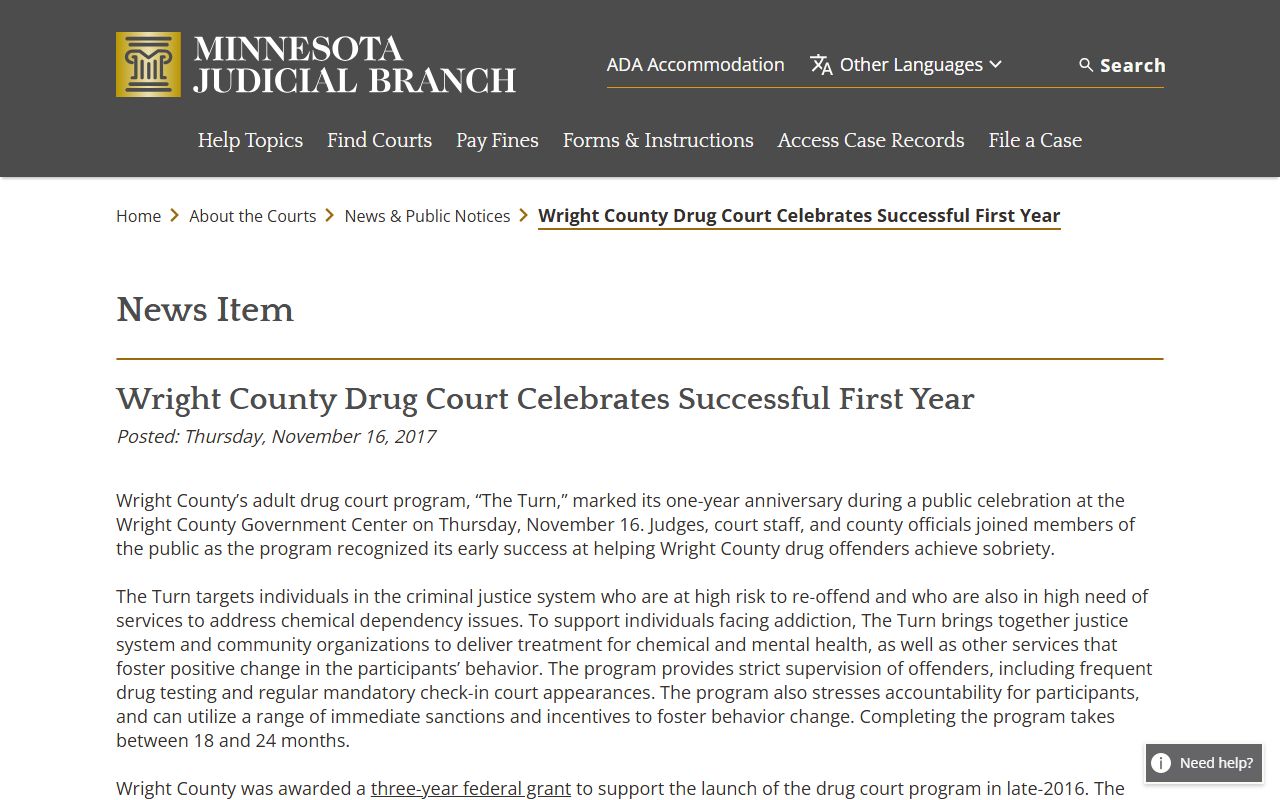
The Drug Court news item shows how Wright County treatment-court work is reflected in official court reporting and news coverage.
Public Access to Criminal Court Records
Criminal court records are public by default under Minnesota court-access rules, but public does not mean unlimited. MCRO may hide street addresses, comments, juvenile files, protected family-abuse matters, and other restricted content. Some documents filed before the online-access window are not remote. The BCA criminal-history system is also separate from the court file. It is useful for statewide history, but it is not the criminal case record.
| Authority | Plain-English meaning |
|---|---|
| Minnesota Statutes § 13.03 | Government data are public unless another law says otherwise. |
| Minnesota Rules of Public Access | The court rule set that controls online and courthouse access. |
| Minnesota BCA Public Criminal History Search | Separate statewide criminal-history lookup, not the court file. |
| Minnesota Statutes § 609A.03 | The petition process for expungement and the filing-fee rule. |
Specialty Courts in Wright County
Wright County Drug Court, called The Turn, is the county’s treatment-court program. It is tied to the criminal case, but it is not a separate record repository. The program is aimed at people in the criminal justice system who have substance-use disorders and need supervision, treatment, and court review. Probation and Court Services is part of that picture because supervision and progress reports often show up in the criminal file.
Wright County’s local treatment court is one of the clearest examples of how a criminal case can move beyond a single plea or sentence. The record may show treatment checks, testing, review hearings, and supervision terms that sit beside the ordinary criminal docket.
Source: Wright County Drug Court / The Turn.
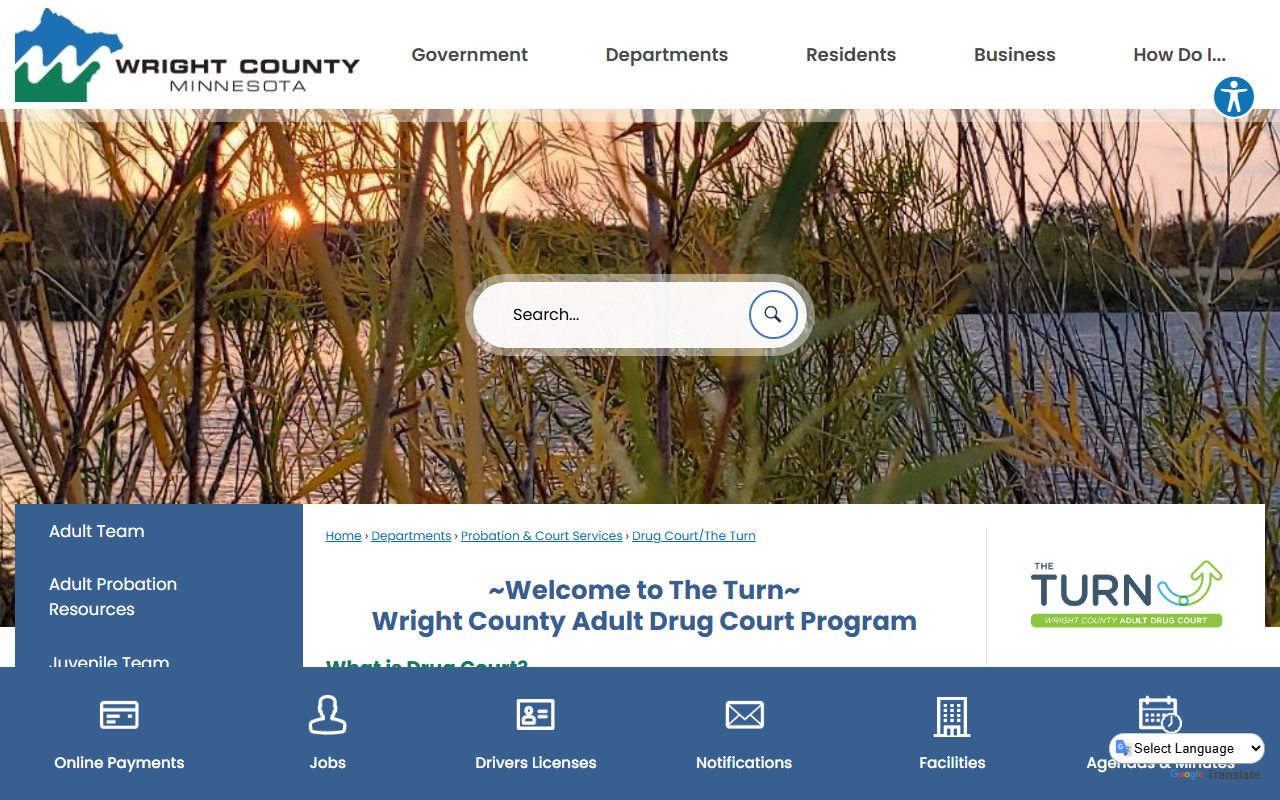
The Turn is the local specialty-court program that most directly affects Wright County criminal case records.
Background Check Considerations
A criminal court record lookup is not a consumer background check. The court file is a public record search. A consumer reporting product carries different legal duties under the Fair Credit Reporting Act. That is why a criminal case search can be useful for review, while a background-check decision has to follow the proper legal standard and source set.
Important: Wright County Court Records is not a consumer reporting agency, and the site cannot be used for FCRA-regulated credit, tenant, employment, or insurance screening.
Restricted Criminal Court Records in Wright County
Some criminal records stay out of normal public search. Juvenile matters, sealed cases, expunged records, and certain sensitive matters can be hidden or partly limited online. Pending criminal cases without a conviction can also be harder to find by name than by case number. That is why the absence of a result is not proof that nothing exists.
When a record is restricted, the next step is Court Administration. If a record was expunged, the court file may be sealed from ordinary public access while some government systems still keep limited references. If the file is juvenile or sealed, the public route may stop at the courthouse. The rule is simple: use the case number, then ask the local office that keeps the file.